Marie-Laure LeBlanc
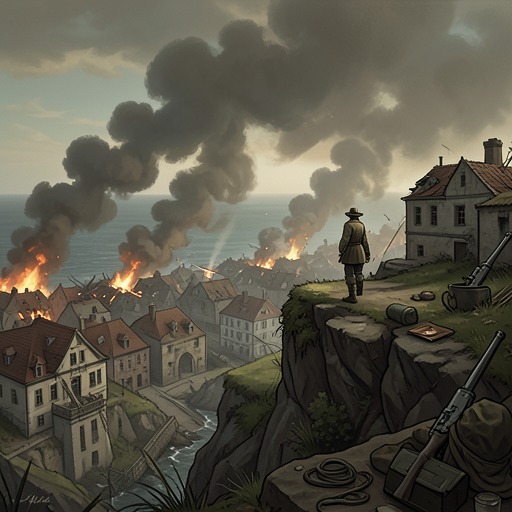
All the Light We Cannot SeeMarie-Laure LeBlanc’s life is shaped not by the absence of sight but by the ways she learns to know, remember, and move through the world. As a blind child displaced by war, she studies cities through touch, sound, and repeated journeys; in Saint-Malo, those skills become a form of independence. Her story eventually carries that attentiveness from a miniature model and a hidden wartime broadcast to a career spent studying living mollusks.
Identity and Early Learning
Marie-Laure is sixteen when the narrative finds her in Saint-Malo, kneeling at a low table in the sixth-floor home at Number 4 rue Vauborel. Her hands travel over a detailed model of the walled city: the cathedral, the old château, shops and hotels, a jetty, the seafood market, benches, and public squares. She traces the ramparts and identifies their bastions and streets by name. The model is not simply a representation to inspect; it is a map she can read with her fingertips, linking particular routes and structures to the city around her.
That ability has been learned gradually. In Paris, her father, Daniel LeBlanc, asks her to find the way home after taking her to unfamiliar starting points. At first she leads him on long detours and becomes angry and frustrated. During the winter of her eighth year, however, she begins matching the miniature details in their kitchen model to the real city: storm drains, benches, trees, lampposts, and doorways. On a snowy Tuesday in March, near the Seine, she recognizes that she can find the way back without the dread that had accompanied the exercise. The change is small in distance—she approaches home block by block—but large in what she understands herself to be capable of doing.
Her memories of Paris include a more intimate lesson in trust and movement. Daniel places her on the seat of his bicycle and pedals through the city while she holds his hips. The remembered ride, with its traffic, hills, and crowded streets, later returns to her as she tries to understand the dangers around her. Her father’s care is therefore both practical and affectionate: he teaches her routes and gives her experiences that remain available to her after she has been taken far from home.
Displacement and Life in Saint-Malo
Marie-Laure leaves Paris with Daniel in an old furniture lorry carrying a dozen people under a waxed canvas tarp. As the vehicle moves from highway to country road and then to a dirt lane, she tries to believe the journey is an elaborate test and that she will soon return to the familiar kitchen, model, sugar bowl, and daily routines. The imagined return makes the scale of the displacement plain: home is not only an address but a set of ordinary details she expects to recover.
At Number 4 rue Vauborel, she lives with her great-uncle Etienne LeBlanc and Madame Manec. While the house and city are new to her, she learns their layout systematically. The first floor is Madame Manec’s domain, with its kitchen, dining room, foyer, antique dishes, and bedroom. Eleven winding steps lead to the second floor; the third holds jars, metal disks, tools, and engineering manuals; the fourth is crowded with machine parts and dollhouses. Etienne’s large study occupies the fifth floor. Learning the building means making a usable mental geography out of its rooms, stairs, objects, and changes in sound.
Daniel’s anxious habits are visible during the period when Marie-Laure stays with the family: he repeatedly lights matches, moves between Madame Manec’s kitchen, the tobacco shop, and the post office, and keeps turning the clasp on his tool case. He also repairs things around the house. Meanwhile, Etienne alternates between reading to Marie-Laure and withdrawing behind the locked door of his study. Madame Manec offers food and company, sustaining the girl while the adults around her face uncertainties she cannot fully explain.
Marie-Laure’s world in Saint-Malo is not confined to the house. Although Etienne objects that going out is too dangerous, Madame Manec walks her to the beach every morning. Marie-Laure ties her own shoes, finds her way down the stairwell, and waits with her cane. She insists that Madame Manec need not lead her. She learns the route through its measured distances: twenty-two paces to an intersection, forty more to a gate, and nine steps down to the sand. In another early walk through the city, rain, uneven cobbles, and echoes make the streets feel maze-like; nevertheless, the repeated walks give her a practical knowledge that warnings alone could not provide.
War, Radio, and the Model City
The miniature becomes especially significant when danger reaches Saint-Malo. As sirens sound and aircraft approach, Marie-Laure stands alone in her bedroom with a leaflet she cannot read. She closes the shutters, but instead of going downstairs to the cellar, she returns to the model. Her fingers find the ramparts and the Bastion de la Hollande; she connects a modeled window with a real one and recalls a woman who beats rugs there each Sunday. What might look like retreat into a small replica is also an act of orientation: she uses remembered details of the city to hold onto a world that bombardment threatens to make unrecognizable.
The model gives her a way to reconstruct and test space, but it does not make her invulnerable. In the house, she learns to interpret small sounds as evidence. When she hears the outer gate close before the front door, she reasons that whoever entered shut the gate first and is now inside. The sequence makes her knowledge embodied and practical: she attends to timing, sound, and the building’s arrangement to understand a threat she cannot see.
In August 1944, Etienne comes down the ladder and reaches her through the back of a wardrobe. He tells her that Daniel had asked him to keep her safe and warns that what follows will be dangerous, not a game. The exchange gives her a direct link between her father’s absence and Etienne’s responsibility, while placing her in a situation where protection cannot mean simply keeping her still. Later, she opens a novel in her lap, finds the lines with her fingers, and brings a microphone to her lips. Her reading becomes a radio transmission heard by Werner Pfennig, who is trapped beneath the ruined Hotel of Bees. The voice that crosses the distance through the receiver makes a connection before the two have met face to face.
When Werner later sees Marie-Laure leave Number 4 rue Vauborel, he recognizes her blindness from her cane and opaque glasses. He watches her make her way down the cobbled street and into a bakery, her cane finding the storm drains. This encounter is narrated through his observation, but it reveals the competence her own routines have built: she travels through a city under occupation without needing a guide at every turn. Their earlier radio connection and this brief sighting lead toward a meeting inside the house, where Werner helps her out of the wardrobe and takes her hand.
Relationships, Survival, and Aftermath
Daniel’s teaching, Etienne’s protection, and Madame Manec’s practical support contribute different forms of care. Daniel gives Marie-Laure the exercises through which she learns to navigate; Etienne assumes responsibility for her after Daniel is gone and eventually helps her leave hiding; Madame Manec makes the house and the city more accessible by taking her out repeatedly. These relationships do not erase the limits imposed by war, but they give Marie-Laure knowledge and support with which to act within them.
Her recollections of Daniel’s bicycle rides and of being led to snails by Crazy Harold Bazin surface when she fears she may have been discovered. The memories reach across the distance between Paris and Saint-Malo: the girl who once rode through city streets holding her father’s waist remains present in the young woman who must judge danger and decide how to respond. Recollection is not an escape from her circumstances so much as a means of keeping earlier attachments and experiences alive within them.
The model’s construction also becomes the site of a wartime discovery. Marie-Laure counts its 865 buildings and locates the narrow house at Number 4 rue Vauborel. She removes it, hears no sound when she shakes it, and works out how its chimney and roof panels move. The sequence of concealed doors leads to a small locked compartment. The evidence establishes her patient investigation of the house, model, and hidden compartment; the larger significance of the discovery rests on how closely it joins her tactile knowledge to the wartime secrets carried by the model.
Later Life and Narrative Significance
Marie-Laure’s later life extends the attentiveness developed in childhood without reducing it to a wartime survival skill. She manages a small laboratory at the Paris Natural History Museum and contributes to the study of mollusks through research on the folds of West African cancellate nutmeg shells and the sexual dimorphism of Caribbean volutes. She names two new subspecies of chitons and, as a doctoral student, travels to Bora Bora and Bimini. She wades onto reefs with a collecting bucket and gathers snails on three continents.
Her approach differs from that of Dr. Geffard, whose collecting impulse is directed toward ordering specimens by scale, family, genus, species, and subspecies. Marie-Laure values being among living creatures: small animals drawing calcium from water and forming shells. Scientific classification is part of her work, but it is not the whole of her interest. Her research grows from sustained attention to living beings and their environments, an attention that recalls the close, tactile study through which she first learned to navigate.
She travels with Etienne while he is able, including to Sardinia and Scotland, and rides with him on the upper deck of a London airport bus. He buys two transistor radios, dies at eighty-two, and leaves her money. Later, when a visitor and the visitor’s son come to see her, Marie-Laure recognizes that the visitor learned French as a child. The encounter brings another person’s childhood history into her present, but the supplied scene leaves that history unstated. Across the larger arc, Marie-Laure’s significance lies in the distinction between dependence and access: she receives care, yet steadily acquires the means to move, interpret, work, and make decisions in a world that is often arranged without regard for her.